
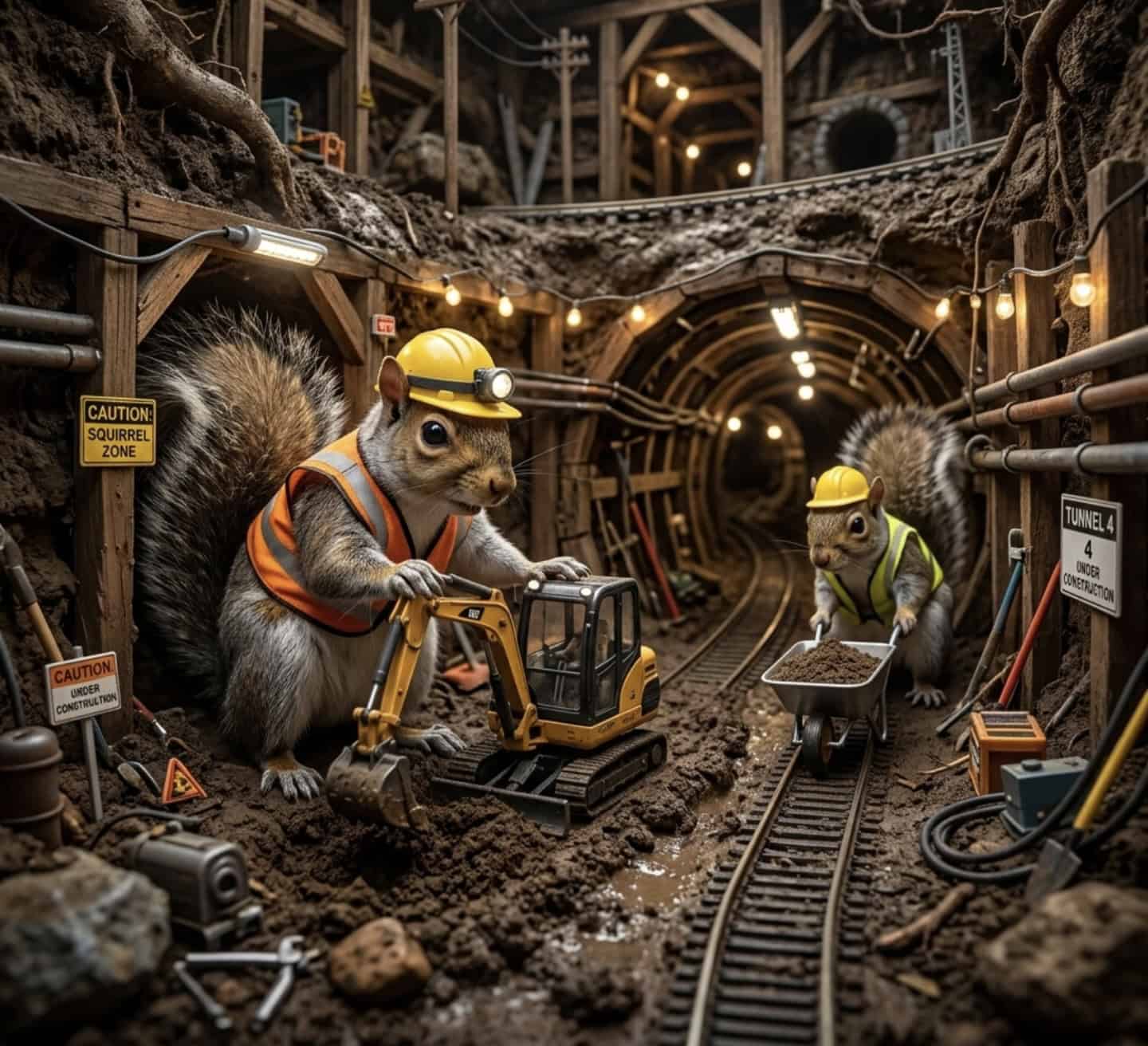

You might have noticed something a little different on your morning walk through the park lately. Perhaps you’ve spotted a flash of neon orange in the bushes or heard a rhythmic, metallic tink-tink-tink sound coming from the base of an old oak tree. It’s okay to feel a bit confused: it’s even okay to check your coffee for hallucinogens: but we’re here to tell you that what you’re seeing is perfectly real. In what is quickly becoming one of the most absurd news stories of the decade, residents across Ontario are reporting sightings of Eastern Grey squirrels wearing miniature, functional hard hats and high-visibility vests.
The consensus among local observers? These rodents aren’t just hoarding acorns anymore; they are deep into the planning and execution of a massive, secret underground subway system. If you’ve been following our news updates, you know that the animal kingdom has been getting increasingly organized, but this latest development in “Rodent Rapid Transit” (RRT) takes the cake.
The First Sightings: Evelyn Thistledown’s Discovery
It all started in Barrie, Ontario, near the scenic trails of Sunnidale Park. Evelyn Thistledown, a retired librarian with a penchant for identifying rare mosses, was the first to document the phenomenon. “I was just checking on a patch of Bryum argenteum,” Evelyn told us while adjusting her spectacles. “I heard a tiny whistle, the kind a foreman might use to signal a lunch break. When I looked up, there was a squirrel: I named him ‘Skyler’: wearing a bright yellow helmet and carrying what looked like a rolled-up blueprint made of dried birch bark.”
Evelyn’s experience might sound like a fever dream, but it’s a sentiment shared by many in the community. You aren’t alone if you find this startling. It’s important to acknowledge your feelings of disbelief; after all, news articles usually involve humans doing silly things, not rodents engaging in sophisticated civil engineering.

Expert Analysis: The “Nut-Line” Infrastructure
To get to the bottom of this, we reached out to Bernard Pendergast, a self-described “Rodent-Urbanist” and former professor of Interspecies Logistics. According to Dr. Pendergast, the squirrels have likely reached a “tipping point” regarding tree-to-tree congestion.
“You have to look at the data,” Pendergast explained while showing us a series of blurry photographs featuring tiny orange traffic cones placed around a hollowed-out root. “The canopy is overcrowded. With the recent population boom, the ‘Leafy Highway’ is seeing record delays. These squirrels are smart. They’ve realized that the real real-estate is below the frost line. They are building what I call the ‘Nut-Line’: a high-speed burrow system designed to bypass human foot traffic and lawnmowers.”
This level of organization shouldn’t come as a total surprise. We’ve seen similar bureaucratic shifts in the wild recently. For instance, the recent Canada Goose bird passports migration policy showed us that feathered travelers are tired of being treated like common trespassers. And if you think squirrels lack the flair for accessories and public image, consider this very real Business Insider story about a man making tiny 3D-printed hats for squirrels, which strongly suggests the species has already embraced workplace dress codes. If geese want legal documentation, why wouldn’t squirrels want a reliable commute?
Labor Unions and Tail-Flicks
Of course, a project of this scale requires a massive workforce. Witnesses have reported seeing groups of squirrels gathered around park benches, appearing to engage in “intense collective bargaining.” One resident claimed he saw a squirrel holding a tiny sign that read “More Walnuts, Fewer Hawks.” Another said you can tell which crew handles storage logistics because they keep disappearing under parked vehicles—an allegation that feels less ridiculous after this Metro News report on squirrels stashing acorns in car engines. In other words, if they can weaponize your sedan as a pantry, they can probably manage a transit supply chain.
This mirrors the global trend of animal activism we’ve seen in our satire articles, such as when pigeons unionized in Asia to demand hazard pay for breadcrumb exposure. It seems the squirrels have taken a page out of the avian playbook, ensuring that their tunnel-diggers are well-compensated in premium, non-GMO sunflower seeds.

The Bylaw Dilemma: Officer Rick Henderson Weighs In
Not everyone is thrilled about the unauthorized construction. Officer Rick “The Wall” Henderson, a local bylaw enforcement officer who usually spends his days ticketing people for overgrown hedges, is reportedly “at his wit’s end.”
“I tried to serve a cease-and-desist order to a burrow near the playground,” Henderson said, sighing deeply. “A squirrel in a foreman’s hat just chattered at me for ten minutes and then dropped a pebble on my shoe. Technically, our bylaws don’t cover subterranean transit systems built by non-human residents. It’s a legal grey area the size of a provincial park.”
The lack of regulation is a common theme in modern fake news satire. When the rules of the world seem to be shifting under your feet: sometimes literally: it’s helpful to remember that even the authorities are often just as confused as you are. Whether it’s squirrels building subways or the fact that Moose Jaw officially appointed an actual moose as mayor, the traditional structures of power are looking a little… furrier these days.

How to Support Your Local Construction Squirrel
If you encounter a construction site in your backyard, your first instinct might be to fill the hole. But we encourage you to take a breath and consider the squirrels’ perspective. They are simply trying to improve their community’s infrastructure. Here are a few tips for being a good neighbor:
- Respect the Cones: If you see tiny orange caps (often repurposed Lego pieces or painted acorns), do not step on them. These indicate high-voltage acorn storage or unstable soil.
- Offer “Grants”: Instead of shooing them away, consider leaving a small pile of pecans near the site. Think of it as a private sector investment in the future of transit.
- Stay Informed: Keep an eye on local news. If the squirrels start installing miniature LED lighting or turnstiles, you’ll want to be the first to know.
It’s a strange world, isn’t it? One day you’re reading about a local teen winning a doubles championship with a tennis partner who died in 1922, and the next, you’re worrying about rodent-led gentrification in your flower beds. But that’s the beauty of living in the present: anything is possible, and usually, it’s hilarious.
A Glimpse into the Future
What’s next for the “Nut-Line”? Dr. Pendergast believes the squirrels are currently scouting locations for a “Grand Central Station” located directly beneath the bulk bin section of a local bulk-food store. “The ambition here is staggering,” he notes. “We’re looking at a three-phase rollout. First, the local tunnels. Second, inter-neighborhood express routes. Third? Possible integration with the chipmunk burrows, though negotiations there are currently stalled due to territorial disputes over buried peanuts.” He also pointed to outside evidence that squirrels have been quietly reshaping public infrastructure for some time, including TwistedSifter’s report that Chicago’s famous ‘Rat Hole’ was apparently made by a squirrel. “Once a squirrel leaves a mark in concrete,” Pendergast said, “you’re no longer dealing with wildlife. You’re dealing with urban planners.”

As you go about your day, keep your eyes on the ground. If you see a squirrel checking a tiny silver pocket watch or pointing aggressively at a pile of dirt, just give them a nod of respect. They have a schedule to keep, and according to their blueprints, the 5:15 “Acorn Express” is running right on time.
In the world of absurd news stories, we often find that the truth is stranger than fiction: mostly because we make the fiction up as we go. But for now, the hard hats stay on, the tunnels go deeper, and the Canadian squirrel population continues its march toward a more connected, subterranean future. Stay safe out there, and watch your step: you might just be walking on the roof of a very tiny, very busy subway station.


Leave a Reply